


Washer not spinning. Clothes come out soaking wet, dripping all over the laundry room floor. You open the lid, stare at a drum full of water, and think: dead machine. Time to buy new. Hold on. I take appliance repair in Sarasota calls about washers that won’t spin probably five or six times a week. More than half the time it’s something I fix in under thirty minutes for less than $200. The other half — yeah, sometimes it’s a motor or a transmission and the numbers don’t add up. But you won’t know which camp you’re in until you work through the list.
So let’s work through it. Cheap and easy stuff first, expensive stuff last. By the end you’ll either fix it yourself or know exactly what to tell the tech when they walk in.
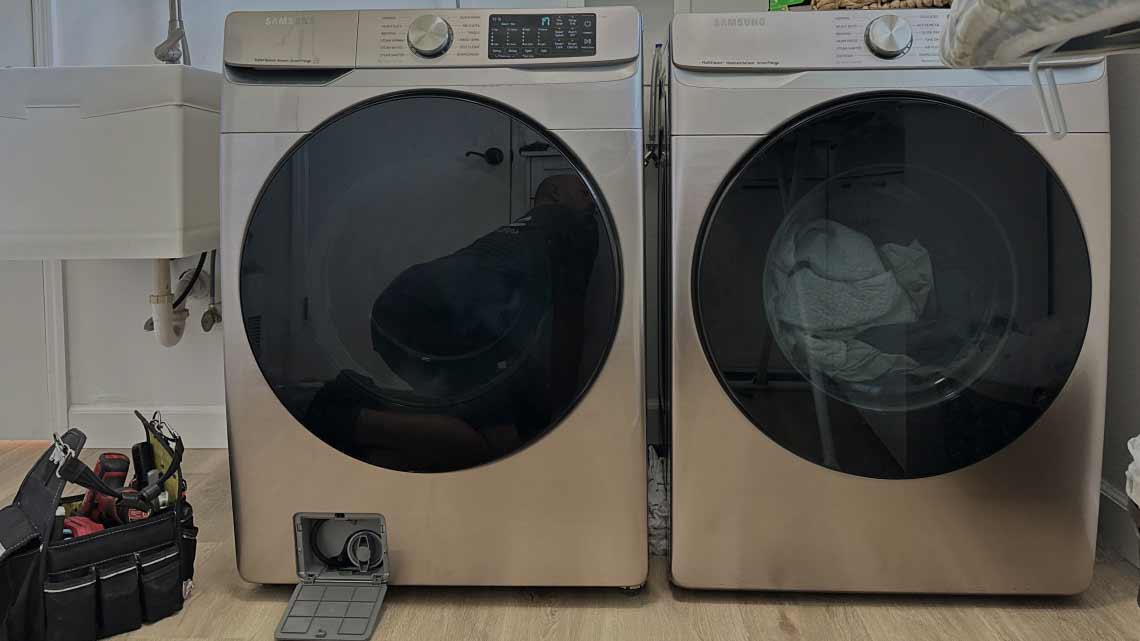
1. Overloaded or Unbalanced
The machine is stuffed to the brim. Comforter folded in half, jeans piled on one side, three bath towels crammed on top. The washer tries to spin, detects the load is unbalanced, and shuts the cycle down. Safety feature. It’s protecting itself from ripping apart.
WHAT TO DO:
- Open the lid. Pull half the stuff out. Redistribute what’s left so the weight is roughly even around the drum. Close the lid. Restart the spin cycle. If it goes — congratulations, your washer is fine. You just overloaded it.
- Front-loaders are pickier about this than top-loaders. A single heavy item — a king-size comforter, a soaking wet rug — can throw the balance off enough to trigger the sensor. Spread heavy items around the drum. Don’t bunch them.
- Also check: is the machine level? Grab a bubble level, set it on top. If it wobbles at all, adjust the feet. A washer that’s rocking even slightly might refuse to hit full spin speed. Takes sixty seconds to fix. Saves a service call.
2. Lid Switch and Door Lock
Top-loaders have a lid switch — a small plastic tab that clicks when the lid closes. If the switch fails, the washer thinks the lid is open and won’t spin. Safety interlock. Won’t even try.
TEST:
Close the lid and listen for the click. No click? Push the switch manually with a pen. Still nothing? Dead switch. $150–$200 installed, fifteen-minute job. I’ve swapped these on machines that were twelve, thirteen years old and they ran for years after.
Front-loaders use a door lock assembly instead. Same idea — the machine won’t spin unless the door is locked and confirmed by the control board. If the lock mechanism fails or the wiring cracks (common on LG and Samsung after three or four years), the board never gets the “door locked” signal and the cycle stalls.
Door lock replacement runs $180–$250. SRQ Appliance Repair techs do them constantly — it’s one of the top front-loader repairs in Sarasota.
3. Drive Belt Snapped or Slipping
Older top-loaders and some front-loaders use a rubber belt to transfer motor rotation to the drum. Belt breaks, drum stops spinning. Simple as that. The motor runs — you can hear it humming — but the drum sits there doing nothing.
WHAT TO DO:
- Open the access panel (back panel on front-loaders, bottom on some top-loaders).
- Look at the belt. Snapped? Obvious — it’s lying in the bottom of the machine or hanging loose.
- Glazed and shiny? That means it’s been slipping for weeks and finally lost grip.
Belt costs maybe $15–$25. The labor is in getting to it. Total repair: $150–$250.
Not a difficult DIY job if you’re comfortable pulling panels off, but the belt routing path can be tricky on certain models — GE top-loaders in particular have a weird zigzag pattern that’s easy to get wrong.
4. Motor Coupler
This one is mostly a Whirlpool and Kenmore direct-drive top-loader thing. The motor coupler is a small plastic and rubber connector between the motor and the transmission. Cheap part. Breaks on purpose — it’s designed to fail so the motor and transmission don’t destroy each other when the washer jams.
Symptoms:
- The washer fills, you hear the motor running, but the drum doesn’t agitate or spin.
- Or it agitates weakly and won’t spin at full speed.
- Sometimes you’ll hear a grinding or humming noise from underneath.
The coupler itself is a $10 part. Replacing it means tilting the machine back, removing the motor, and swapping the coupler. The whole job takes forty-five minutes.
Total cost installed: $150–$200.
Had a customer in Bee Ridge last spring — Whirlpool Cabrio, five years old. She was already pricing new washers on her phone when I told her it was a ten-dollar coupler. I fixed it in under an hour. The machine’s still running.
5. Clutch Assembly (Top-Loaders Only)
The clutch sits between the transmission and the inner tub on top-loaders. It’s what engages the spin cycle — when it wears out, the drum either won’t spin at all or spins slowly and leaves clothes soaking wet. Sometimes you’ll smell burning rubber from underneath, which is the clutch pads grinding.
Clutch replacement: $200–$300. More labor-intensive than a coupler swap because you’re working around the transmission. But it’s a defined repair — clutch in, clutch out, done.
If the washer agitates fine but won’t spin, or spins weakly enough that clothes come out drenched — the clutch is high on the suspect list. Especially on Whirlpool and Maytag direct-drive models from the last ten years.
6. Drain Pump Clog Killing the Spin
Here’s one that confuses people. The washer won’t spin — but the actual problem is it won’t DRAIN. And if it won’t drain, most machines won’t enter the spin cycle. Safety feature again. The machine won’t whip a tub full of water at 800 RPM.
WHAT TO DO:
- Open the drain pump filter if your front-loader has one — that little door at the bottom front.
- Lay towels down first because water is coming out.
- Check for coins, bobby pins, hair ties, buttons, that rogue sock that vanished three months ago.
If the filter is clean and there’s still standing water, the pump motor itself might be dead.
Pump replacement: $200–$300.
Washer not draining or spinning is one combined problem about 40% of the time. Fix the drain, get the spin back.
7. Control Board and Timer
Modern washers have an electronic control board managing every cycle phase. If the board glitches — power surge, brownout, lightning strike during a Sarasota summer storm — it can skip the spin cycle entirely or stop mid-cycle with an error code.
WHAT TO DO:
- First try: unplug the washer for five minutes, plug back in. Hard reset. Clears software glitches more often than you’d expect.
- Still no spin? Look at the display. Error code? Google the code plus your model number. Some codes point directly to the spin problem — motor control fault, unbalanced load detection stuck, door lock signal missing.
Older machines use a mechanical timer instead of a board. Timer contacts wear out, the cycle dial skips over the spin portion. You can sometimes hear the timer click through without engaging.
Board replacement: $250–$400. Timer: $150–$250.
Sarasota appliance repair techs carry test equipment to diagnose board vs timer vs wiring in about fifteen minutes — saves you from guessing and ordering the wrong part off Amazon.
8. When the Motor Actually Dies
If you’ve ruled out everything above — belt is fine, coupler is fine, clutch is fine, pump drains, board sends voltage — and the motor just sits there silent when the spin cycle should kick in, the motor is dead.
WHAT TO DO:
- Touch the motor after a failed cycle attempt:
- Warm but not spinning? Motor winding is probably shorted.
- Hot to the touch? It’s been trying and failing.
- Completely cold? It’s not getting power — go back to the board.
Motor replacement runs $300–$450 installed. At that price, on a machine under six or seven years old, it usually makes sense. Over ten? Do the math against a new washer. I covered the full breakdown in our washer repair vs replace guide.
Name:
SRQ Appliance Repair
Address:
3959 Yellowstone Cir Sarasota 34233
Phone:
(941) 233-0641
Website:
https://srq-appliancerepair.com/
Hours:
Mon-Fri: 8:00 a.m. – 7:00 p.m.
Sat: 10:00 a.m. – 2:00 p.m.
Sun: Closed
Frequently Asked Questions

Hi Sarasota! My name is Vitalii. I’ve been repairing home appliances in Sarasota and the surrounding areas for many years. I know this field inside and out! Here I share my experience and practical tips. I’d truly appreciate your shares, questions, and comments. Thank you!