


- The drive belt has snapped or slipped off the drum.
- The idler pulley seized or lost its spring tension.
- The drum rollers or axles are worn and dragging.
- The rear drum bearing has gone, and the drum binds.
- The motor hums but can’t turn the drum.
- The door switch isn’t registering that the door is shut.
- The start switch is worn and won’t catch.
- The thermal fuse blew and cut power to the motor.
- The load is too heavy or too wet for the drum to move.
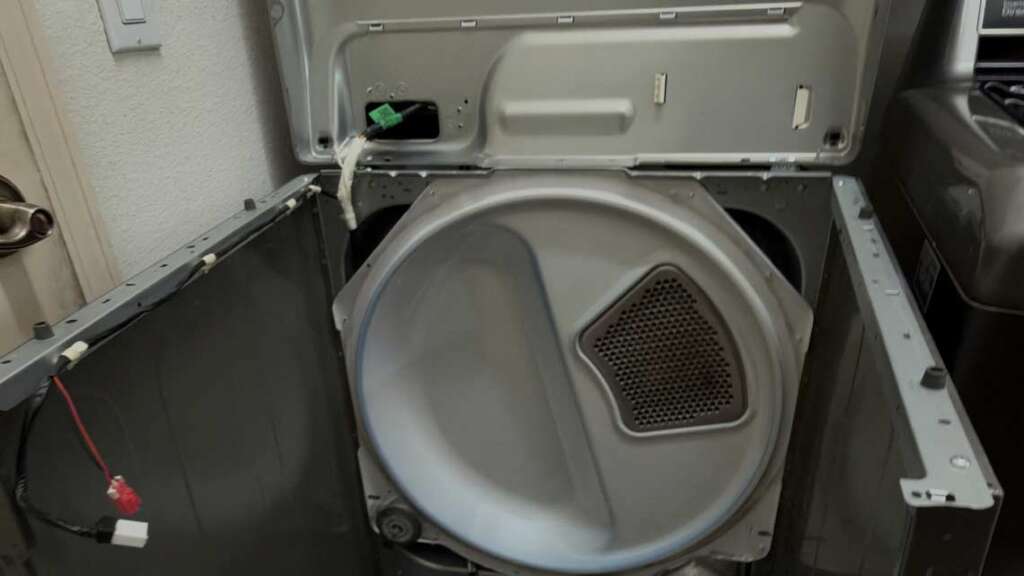
You press start, the panel lights up, maybe you hear a low hum — and the drum just sits there. The clothes come out in the same damp heap, because nothing ever tumbled. Plenty of people in Sarasota start pricing a new dryer that same afternoon.
Hold off on that. A dryer that won’t spin is usually one small part, not the end of the machine, and the most common culprit by far is a drive belt you can replace for about fifteen dollars. If you’d rather hand it off, an honest appliance repair Sarasota tech will have it tumbling again in one visit — but a few of these checks are free. Everything here is for electric dryers; gas models play by different rules, and we don’t touch those.
1. First — Does It Hum, or Sit Silent?
Before you pull a panel, listen — this clue splits the job in half. A hum or buzz with no movement means the motor has power, so something mechanical is stopping the drum — a broken belt, a seized pulley, or a motor that can’t overcome the drag. Dead silence means power isn’t reaching the motor at all, which points at a switch, the thermal fuse, or the door.
💡 Tip: With the dryer unplugged, open the door and spin the drum by hand. If it turns freely with a light whoosh, your belt is almost certainly broken. If it’s stiff, drags, or grinds, the trouble is in the rollers, the bearing, or the pulley.
2. Start With the Belt
The drive belt is a thin rubber loop that wraps around the drum and down to the motor pulley. The motor spins, the belt grips the drum, the drum turns. It’s the hardest-working part in there and the first place I look when a dryer runs but won’t spin — when it snaps or slips off, the motor hums along while the drum does nothing. Spin the drum by hand and a broken belt lets it flop around loose.
💡 Tip: A belt is one of the few dryer repairs a handy person can take on. The part is cheap and easy to find for Whirlpool, Maytag, GE, and Kenmore. The catch is the routing — it has to thread around the idler pulley in exactly the right path, so snap a photo of the old one before it comes off.
3. The Idler Pulley Holds the Tension
Next to the belt is the idler pulley, a small wheel on a spring arm that keeps the belt tight against the motor. Over the years its bearing wears out or the spring tires, and the belt slips instead of gripping — so the drum turns slowly, stutters, or stalls under a wet load. A failing idler usually squeals or chirps as the dryer warms up.
If you’ve got a belt that keeps slipping off or wearing out fast, the pulley is often the real reason. When a tech from a good Sarasota FL appliance repair outfit swaps a belt, they check the pulley and the motor glides in the same breath, because all three wear together.
4. Drum Rollers and Their Axles
The drum doesn’t just hang off the belt — it rides on small rollers, two at the back and sometimes two up front, that carry its weight as it turns. Load after load wears flat spots into the rollers, or the axles they spin on dry out and seize, and the drum drags against them. That shows up as a loud rhythmic thumping or grinding, or a drum that’s hard to turn by hand. Push it far enough and a roller locks up, and the belt burns through trying to force the drum past it.
💡 Tip: If a new belt chewed up or flew off within a few loads, don’t blame the belt. A seized roller or dry axle behind the drum is almost certainly fighting it, and that’s the part actually asking to be replaced.
5. The Rear Drum Bearing
At the very back, the center of the drum spins on a bearing. When it wears out, the drum sags and binds against the back wall, and the motor has to work far harder to turn it. A bad one won’t move at all; a marginal one grinds, metal on metal, through the cabinet. It sits deep behind the drum — reaching it means pulling the dryer apart, a real teardown, not a casual Saturday job.
6. When It Hums but Won’t Turn — the Motor
Here’s the test everyone dreads. If the belt is intact, the pulley’s fine, and the drum turns freely by hand, but the motor only hums and never gets it moving, the motor itself is likely done. A dryer that won’t spin and just hums is the classic sign of a motor with worn bearings or a failed start winding — it draws power but can’t build the torque to start the drum.
Sometimes it isn’t the motor at all — a dried-out pulley and a couple of seized rollers create so much drag a healthy motor can’t win. That’s why the hand-spin test matters — it tells a worn motor apart from one losing a fight with stiff parts. Sorting that out takes a meter, and it’s where guessing gets expensive.
On a no-spin call, I don’t reach for the motor first — I reach for the belt. Nine times out of ten the drum spins free in my hand and the belt’s lying in the bottom of the cabinet, and that’s a quick, affordable fix. The motor only comes into it after the belt, the pulley, and the rollers all check out. Replacing a $400 motor on a dryer that needed a $15 belt is the kind of mistake we’re here to keep people from making.
— Yaremych Vitalii, Owner of SRQ Appliance Repair
7. The Door Switch and the Start Switch
Now the silent cases — no hum when you press start. A dryer won’t run with the door open, so a little door switch has to confirm the door is shut before anything turns. When it fails, the machine thinks the door is open and won’t spin, even though everything mechanical is fine.
💡 Tip: Watch the interior light. If it stays on with the door shut, or the switch doesn’t click firmly when you press the door closed, the door switch is a strong suspect — an inexpensive part.
The start switch is the other silent culprit. Press start and get nothing, no hum or click, and it may be worn out and not completing the circuit. Both are electrical, both are cheap, and both get overlooked because the dryer looks dead.
8. A Blown Thermal Fuse
The thermal fuse cuts power if the dryer overheats, and on many models a blown one kills the motor circuit — the drum won’t turn and the machine sits silent. The fuse itself is cheap, but it rarely fails on its own. It blows because something made the dryer run too hot, and in Sarasota that something is almost always a clogged lint vent trapping the heat.
💡 Tip: Replacing the fuse without clearing the vent is a dead end — the new one blows within a load or two. Clear the full vent run to the outside wall first — you fix the no-spin and kill a fire hazard at once.
9. Overloading and Soaking-Wet Loads
Not every no-spin is a broken part. Cram the drum past about two-thirds full, or load clothes that came out of the washer soaking wet, and the sheer weight can be more than the belt and motor will turn. The drum strains, stalls, or won’t start — and over time that overload is exactly what wears out the belt and pulley early. If it stalls only on big loads and spins fine with a light one, you don’t have a broken dryer; you have a loading habit to break.
Why a Dryer Won’t Spin: Causes at a Glance
What You Can Handle vs. When to Call
often for free: the hand-spin test, the door and start switches, a cleared vent behind a blown fuse, and your load size. A confident DIYer can take on a belt or a switch too.
worn rollers, a failed rear bearing, or a motor that hums but won’t turn. Those sit deep behind the drum next to 240-volt wiring, need the dryer mostly disassembled, and a bad motor takes a meter to confirm. That’s where SRQ Appliance Repair earns its keep — same-day service across Sarasota, Bradenton, Venice, and Lakewood Ranch, upfront pricing, and the right diagnosis before any part gets bought.
Key Takeaways
- Listen first. A hum with no spin is mechanical — belt, pulley, or motor. Dead silence is electrical — a switch, the fuse, or the door.
- Spin the drum by hand. Free and loose means a broken belt, the cheapest, most common fix. Stiff or grinding points to rollers, the bearing, or the pulley.
- Belt, pulley, and rollers wear together. Replacing just the belt when a roller is seized throws the new belt off within days.
- A blown thermal fuse is a symptom, not the disease. Clear the clogged vent that overheated it, or the next fuse blows just as fast.
Name:
SRQ Appliance Repair
Address:
3959 Yellowstone Cir Sarasota 34233
Phone:
(941) 233-0641
Website:
https://srq-appliancerepair.com/
Hours:
Mon-Fri: 8:00 a.m. – 7:00 p.m.
Sat: 10:00 a.m. – 2:00 p.m.
Sun: Closed
FAQ

Hi Sarasota! My name is Vitalii. I’ve been repairing home appliances in Sarasota and the surrounding areas for many years. I know this field inside and out! Here I share my experience and practical tips. I’d truly appreciate your shares, questions, and comments. Thank you!