


Before you blame the oven, prove it’s wrong — because half the time it isn’t the oven, it’s the recipe, the pan, or where the rack sits.
Buy a standalone oven thermometer. Five dollars at any grocery store. Hang it on the middle rack, set the oven to 350°F, and let it fully preheat plus another ten minutes so the walls stabilize. Then read it. If it says 350, your oven’s fine and the uneven baking is coming from somewhere else. If it reads 300 or 400, now you’ve got a real temperature problem worth chasing.
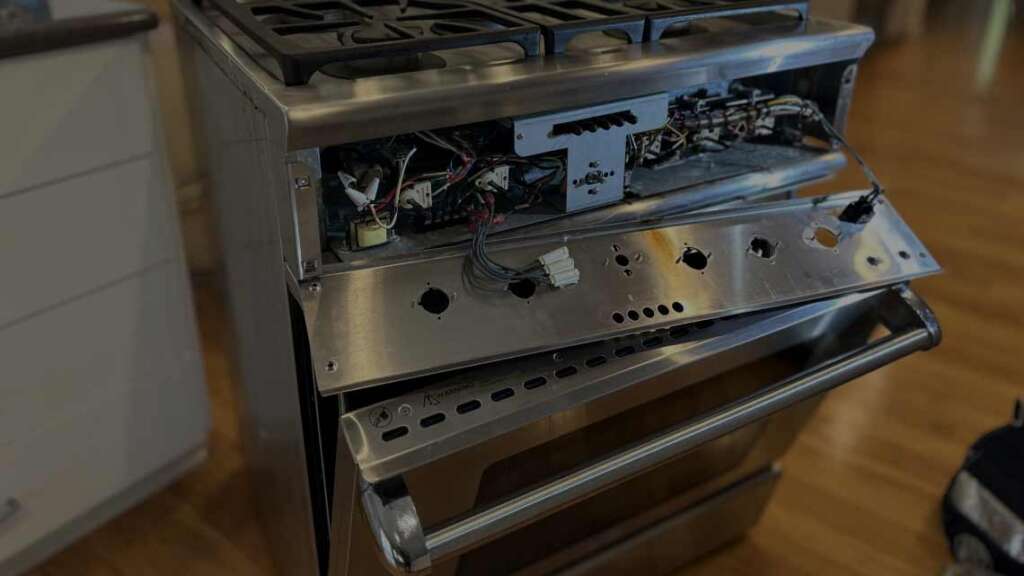
That one test saves people from a service call constantly. I take appliance fix Sarasota FL calls where the “broken” oven turns out to be dead-on accurate — the cookies burned because the pan was on the top rack under the broil element, not because the oven lied. Test first, diagnose second.
Runs Hot, Runs Cold, or Just Uneven?
The way it’s wrong points you to the cause, so pin it down with that thermometer.
- Runs consistently hot or cold — every setting reads the same amount off, say 25 degrees low across the board. That’s a calibration or sensor issue, and often the easiest fix on this list.
- Reads right but bakes unevenly — thermometer says 350, but one side of the tray browns and the other stays pale. That’s airflow, a weak element, or a door leak, not a temperature-reading problem.
- Never reaches the setting at all — climbs partway and stalls, or takes forever. Points at a failing element or a sensor cutting heat early.
Three different symptoms, three different repair paths. Sort yours before you touch anything.
The Oven Temperature Sensor
On any modern electric oven, this is the prime suspect when the temperature’s off. The sensor is a thin metal probe sticking into the cavity — usually upper left or back wall — and it constantly tells the control board how hot things are. When it drifts out of spec, it lies on the board. The board thinks the oven hit 350 when it’s really at 300, cuts the heat early, and everything comes out underbaked. Or the reverse — it reads low, the oven overheats, and you scorch the bottoms.
There’s a real test for it. The sensor is a resistance device: at room temperature (around 75°F) it should read close to 1,080 to 1,100 ohms on a multimeter. Way off that number means the sensor’s bad.
It’s a genuinely DIY-friendly part on most ovens — usually one screw inside the cavity and a plug behind the back wall — but confirming the reading is where an appliance repair in Sarasota FL tech saves you from swapping a good part.
Calibrating the Oven Yourself
Before you replace anything, try recalibrating — a lot of “off” ovens just need their offset adjusted. Most digital ovens let you nudge the calibration in the settings. The steps vary by brand, but the idea is the same: you tell the oven “when you think you’re at 350, you’re actually reading 325, so add 25 degrees.” Whirlpool, GE, Frigidaire, and Samsung all have a calibration mode — usually you hold “Bake” and enter an offset, and most units let you adjust plus or minus 35 degrees.
Here’s the catch: calibration only fixes an oven that’s consistently off by a steady amount. If it’s 25 low at 350 but dead-on at 425, that’s not calibration — that’s a failing sensor or element, and adjusting the offset just moves the problem around. Calibrate only when the error is the same across the range.
Check your manual for the exact key sequence. If it’s gone, search your model number plus “calibrate temperature.”
When It’s the Bake Element
An electric oven’s bake element — the coil along the floor — does most of the heavy lifting. When it starts to fail, it doesn’t always die outright; sometimes it just heats weakly.
- A partially failed element glows unevenly — bright in spots, dull in others — instead of a solid, even orange. The oven still heats, just not enough or not fast enough, so it struggles to reach temperature and bakes unevenly. Look at it mid-preheat: patchy glow or dark sections mean the element is on its way out.
- A fully dead element you’ll spot easily — a visible break, blister, or scorch mark, and the oven won’t heat from the bottom at all. Either way, the bake element is one of the more approachable swaps: a couple screws and two connectors. Kill the breaker first.
The Convection Fan Factor
If you’ve got a convection oven, that fan is supposed to circulate hot air for even baking. When it fails or slows, you lose the even part — the oven develops hot and cold zones, and food browns unpredictably.
Signs: the fan’s not spinning when convection’s on, it’s making noise, or convection bakes no more evenly than regular bake. A dead convection fan motor turns your fancy even-heat oven into a plain one with hot spots.
This is more of a tech job — the fan sits behind the back panel with its own motor and wiring. But it’s worth knowing, because people chase the sensor and the element when the real culprit is a fan that quietly stopped moving air. A quick affordable oven repair diagnosis rules it in or out fast.
Door Seal Leaks
Simple one people overlook. The oven door gasket — that rubber or braided seal around the door frame — keeps heat inside. When it wears, tears, or hardens, heat leaks out the gap. The oven then can’t hold temperature steadily. It overshoots, drops, kicks the element back on, overshoots again — and the constant cycling shows up as uneven baking, especially near the door side of the rack.
Check it cold: run your hand around the closed door edge while the oven’s hot (careful) and feel for escaping heat, or inspect the gasket for gaps, crush marks, and brittle spots. A gasket is a cheap, straightforward replacement, and a bad one quietly sabotages every bake.
Hot Spots and How You’re Loading the Oven
Sometimes the oven’s temperature is fine and the unevenness is on you. No shame — most people load an oven wrong.
- Rack position matters more than people think. The top rack sits close to the broil element and browns fast; the bottom rack cooks from the bake element and burns bottoms. For most baking, the middle rack is right, and moving off it changes results dramatically.
- Overcrowding is another big one. Cram two full sheet pans side by side and you block airflow — the oven can’t move heat around, and everything bakes unevenly. Leave space around pans, and rotate trays halfway through if your oven has a known hot corner. Dark metal pans run hotter than shiny ones, too.
None of this is a repair. But it’s why a perfectly accurate oven still turns out lopsided cookies, and it’s worth ruling out before you spend money.
Slow to Preheat, Never Quite There
An oven that takes forever to preheat, or preheats but never holds the setting, usually traces back to two things already covered: a weak bake element or a drifting sensor. A tired element heats slowly because it can’t put out full wattage anymore. A bad sensor makes the oven think it’s done preheating early, so the beep goes off while the cavity’s still cold — you load food into an under-temp oven and wonder why it’s slow to cook.
If your preheat time has crept up noticeably over months, that’s the element aging. If it beeps “ready” but the thermometer says otherwise, it’s the sensor. SRQ Appliance Repair techs test both with a meter and tell you which — no guessing, no swapping parts on a hunch.
What You Can Fix vs. When to Call
Clean split.
- Yours to handle: running the thermometer test, recalibrating the offset, fixing rack position and overcrowding, checking the door gasket, and swapping a bake element or temperature sensor if you’re comfortable — both are among the friendlier oven repairs.
- Tech territory: convection fan motors, control board issues, wiring behind the panel, and any diagnosis that needs a multimeter to confirm before you buy a part. Anything that reads wrong intermittently, or where the sensor and element both test fine, needs someone who can trace it properly.
The whole game with an inaccurate oven is testing instead of guessing — thermometer first, ohms reading second, parts last. Get those in order and you either fix it cheaply yourself or hand the tech a head start.
Name:
SRQ Appliance Repair
Address:
3959 Yellowstone Cir Sarasota 34233
Phone:
(941) 233-0641
Website:
https://srq-appliancerepair.com/
Hours:
Mon-Fri: 8:00 a.m. – 7:00 p.m.
Sat: 10:00 a.m. – 2:00 p.m.
Sun: Closed
Frequently Asked Questions

Hi Sarasota! My name is Vitalii. I’ve been repairing home appliances in Sarasota and the surrounding areas for many years. I know this field inside and out! Here I share my experience and practical tips. I’d truly appreciate your shares, questions, and comments. Thank you!