


An oven that turns itself off is a different headache than one that won’t turn on at all. This one works — it heats, it runs, and then partway through your roast it just quits. Maybe it comes back after it cools, maybe it throws an error, maybe it sits dead for an hour and then acts fine. That on-and-off pattern is the clue. The big split is this: is the oven shutting down because it’s getting too hot, or because something’s cutting power to it? Overheating means a safety is doing its job — the oven’s protecting itself. A power cut means a part’s failing. Both end with a cold oven mid-bake, but they’re opposite problems.
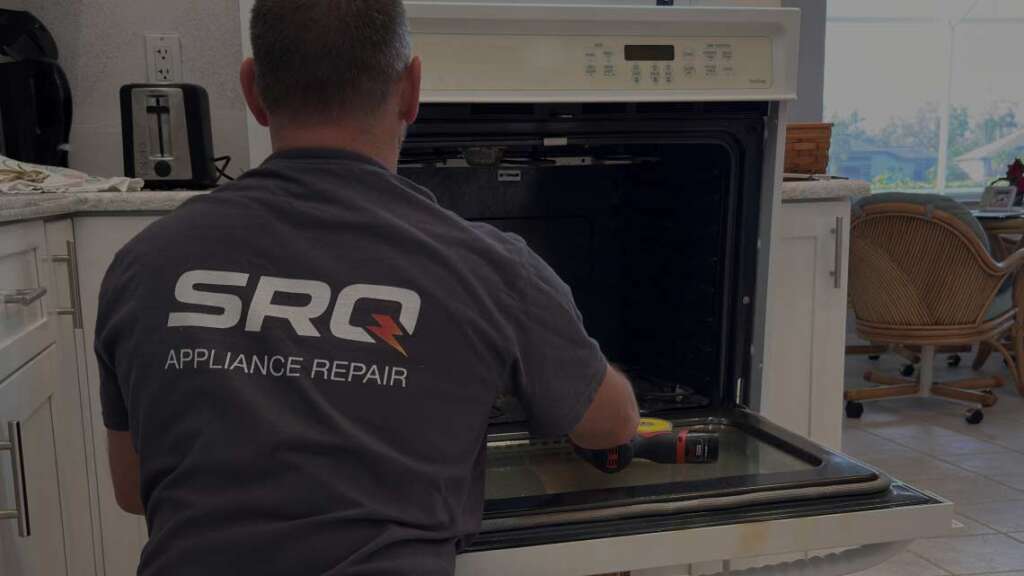
I run appliance repair Sarasota FL calls on ovens that won’t stay on all the time, and the first thing I ask is whether it feels scorching before it dies, or just blinks out. That one detail points me halfway to the answer. This guide’s for electric ovens.
The 12-Hour Auto Shut-Off You Forgot About
Before you panic, rule out this cause — and it’s more common than you’d think. Almost every modern oven has an automatic shut-off that kills the oven after 12 hours (sometimes less) of continuous running. It’s a safety feature, built so a forgotten oven doesn’t run for three days straight. The problem is, people slow-cooking a brisket or holding a dish warm for a long party hit that limit and think the oven broke.
If your oven quit after running a long, long time, that’s probably all it is. Check your manual — most units let you turn the auto-off off, or there’s a “Sabbath mode” that disables it for long holds. Nothing’s wrong with the oven. It did exactly what it was built to do.
That’s the free fix. If your oven’s dying after 30 minutes, not 12 hours, keep reading.
Overheating Trips the Safety
Here’s the most common real fault. The oven climbs past a safe temperature, and a built-in limiter cuts power to protect everything from melting down. Oven goes dark, cools off, and often comes back to life a while later — which is exactly why people say it works “sometimes.”
What makes it overheat in the first place? Usually a temperature sensor feeding the board bad numbers, so the board keeps dumping heat when it shouldn’t. Could also be a stuck relay holding an element on full blast. Either way, the oven cooks past its limit, the safety trips, and down it goes.
The tell: the oven is noticeably hotter than your setting before it quits, or it runs fine on low and only dies at high heat. That heat-then-death pattern almost always means overheating, and an appliance repair tech in Sarasota can pin the cause with a meter instead of you guessing.
A Dying Temperature Sensor
Since the sensor’s behind so many of these, it’s worth its own section.
That thin metal probe sticking into the oven cavity tells the control board how hot things are. When it drifts or fails, it lies — and the board acts on the lie. If it reads too low, the board overheats the oven trying to hit a temperature it thinks it hasn’t reached, and the safety trips. If it reads erratically, the board gets confused and shuts down to be safe.
There’s a real test. The sensor’s a resistance part — around 1,080 to 1,100 ohms at room temperature on a multimeter. Way off that, it’s bad. It’s a fairly DIY-friendly swap on most ovens, usually one screw inside and a plug behind the back wall. But reading it right is where a tech saves you from replacing a good part on a hunch.
The Thermal Fuse That Blows for Good
Some ovens have a thermal fuse — a one-shot safety that cuts power permanently if things get too hot. Unlike the resettable limiter, when this one blows, it’s done. It doesn’t come back. Oven goes dead and stays dead.
Here’s the catch: the fuse blowing is usually a symptom, not the root cause. Something made the oven overheat enough to pop it — and if you just replace the fuse without finding out what, the new one blows too. Nine times out of ten the real culprit is a self-clean cycle. That cycle runs the oven brutally hot on purpose, and it fries thermal fuses more than anything else I see. It’s a big reason I tell people to skip self-clean and wipe the oven by hand.
If your oven died for good — not cycling, just dead — and you’d run self-clean recently, the thermal fuse is the first thing I’d check.
Loose Wiring and a Bad Connection
Sometimes it’s not a fancy part at all — it’s a wire.
Electric ovens run on 240 volts through connections that heat up and cool down thousands of times. Over the years a terminal works loose, or a connection corrodes, and now you’ve got intermittent power. The oven runs fine until that iffy connection shifts or heats up, loses contact, and the oven blinks off. Then it cools, the metal contracts, contact returns, and it works again — maddeningly random.
This one’s tough to chase without a meter and some experience, because the fault hides until it acts up. A loose connection at the terminal block, the bake element, or a wiring harness can all do it. And a bad connection that’s arcing is a genuine fire risk, not just an annoyance — this is squarely a tech job.
The Control Board Giving Up
The board runs the whole show — it reads the sensor, fires the elements, holds the temperature. When it starts failing, one of its relays can drop out mid-cycle and shut the oven down for no obvious reason.
Boards die two main ways:
- Age — components just wear out after enough years.
- Or a power surge — and in Sarasota, with summer storms and hurricane season, surges take out boards in waves.
A board that’s half-cooked by a surge might work most of the time and randomly quit, which is one of the more frustrating patterns to pin down.
Try a hard reset first: cut power at the breaker for five minutes, then restore it. Clears glitches now and then. If it keeps quitting and the sensor, fuse, and wiring all check out, the board’s the prime suspect — and that’s the point where most people call a same day oven repair tech, since the board’s the priciest part and not one to swap on a guess.
A Cooling Fan That Can’t Keep Up
One person is missing. Many ovens have a cooling fan that runs to keep the electronics and control board from cooking during a bake. If that fan fails — bad motor, worn bearing, or just clogged with grease and dust — the board overheats and shuts the oven down to save itself.
The tell here is the fan. If the oven quits and you don’t hear that fan running, or it sounds weak and strained, there’s a real chance the electronics are overheating because nothing’s cooling them. It’s an easy one to overlook because everyone’s staring at the heating elements, not the little fan whose whole job is protecting the brain.
Why Sarasota Is Hard on Ovens
Worth a word, because our conditions genuinely matter here.
- Storm-season power surges are the big one. A strike a few blocks away sends a spike down the line and damages control boards — and a half-damaged board is exactly the kind that works, then randomly quits. Get a surge protector on that circuit after any board repair; it’s cheap insurance.
- Heat and humidity don’t help either. A kitchen that’s already warm gives a struggling cooling fan less room to work, and humidity speeds up corrosion on those electrical connections that go intermittent. None of it causes the problem outright, but it all nudges a marginal oven over the edge faster than it would somewhere dry and cool.
Handle It Yourself or Call Someone
the 12-hour auto shut-off (check if you ran it that long), a control-lock or settings mix-up, a hard reset at the breaker, and listening for whether the cooling fan runs. That clears the easy stuff for free.
overheating faults, temperature sensors, thermal fuses, loose or arcing wiring, control boards, and a dead cooling fan. These need a meter to diagnose and live around 240 volts — and anything that’s arcing or overheating is a fire risk you don’t experiment with.
SRQ Appliance Repair techs chase these down in order — sensor, fuse, wiring, board, fan — testing instead of swapping parts blind, and carry the common ones on the truck so most get fixed in one visit.
The approach: rule out the auto shut-off and a reset yourself, then the moment it’s heat or power related, bring in someone with a meter.
Name:
SRQ Appliance Repair
Address:
3959 Yellowstone Cir Sarasota 34233
Phone:
(941) 233-0641
Website:
https://srq-appliancerepair.com/
Hours:
Mon-Fri: 8:00 a.m. – 7:00 p.m.
Sat: 10:00 a.m. – 2:00 p.m.
Sun: Closed
Frequently Asked Questions

Hi Sarasota! My name is Vitalii. I’ve been repairing home appliances in Sarasota and the surrounding areas for many years. I know this field inside and out! Here I share my experience and practical tips. I’d truly appreciate your shares, questions, and comments. Thank you!