


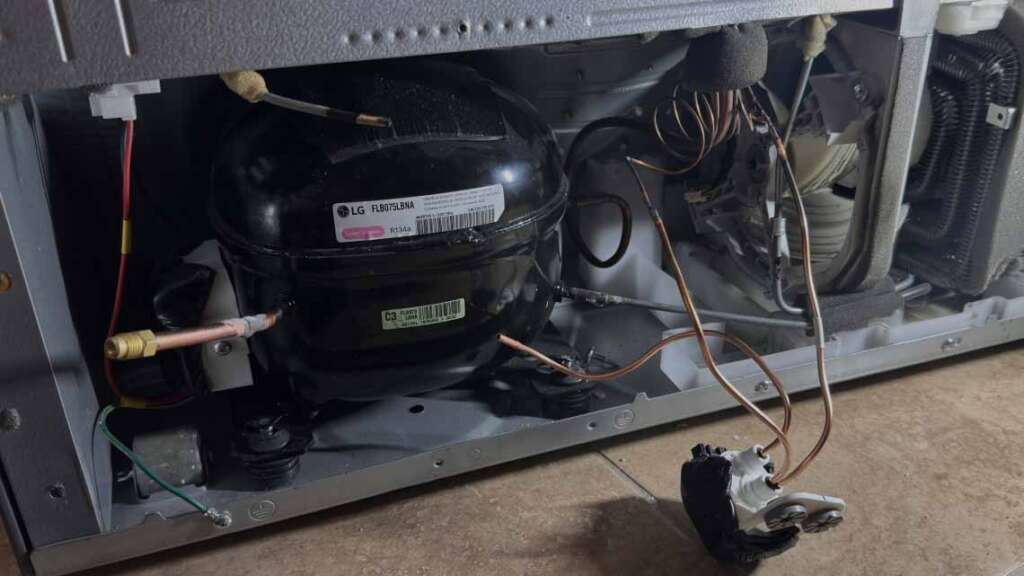
See that black dome-shaped thing at the back of your fridge? That’s the compressor. A pump. It squeezes refrigerant gas, shoves it through the condenser coils to dump heat, then sends it back through the evaporator to cool your food. Round and round, all day. Kill the compressor and the whole cycle dies. Now here’s what trips people up. They hear silence, feel the shelves warming, and think: dead compressor, $800, buy new. Sometimes that’s the reality.
Seven out of ten times when I show up for an appliance repair Sarasota call about a “dead” compressor, it turns out to be something smaller. A $30 relay, a tripped protector, filthy coils.
Listen First — The Noise Tells You Everything
Before you unscrew anything — just stand there and listen. The sound narrows the diagnosis faster than any tool.
- Nothing. Total silence. Light works, zero noise from the back. Could be relay, protector, board, or the motor. But silence alone doesn’t mean the compressor is shot.
- Click… hum… click, every couple minutes. The big one. Relay tries to kick the motor, fails, overload cuts power. Relay’s probably gone. Check it first — twenty bucks.
- Quick loud buzz, then nothing. Motor’s getting juice but can’t physically turn. Seized bearing, bad capacitor, or — I’ve actually seen this — outlet voltage so low from a janky extension cord that the motor couldn’t start. Someone had their fridge on a fifty-foot cord. In Sarasota. In July.
- Runs nonstop but fridge stays warm. Compressor’s spinning, pushing nothing. Refrigerant leaked or internal valve failed.
Start Relay: Cheap Part, Big Drama
If I’m betting on one diagnosis for a refrigerator compressor not running? Bad start relay. See it more than anything. Cheapest fix on the list. The relay plugs onto the compressor terminals. Small device, matchbox-sized. Dumps a burst of current into the motor so it can start spinning. Without that kick, the motor hums for a second and the overload kills it.
New one slides right on. Ten minutes. Plug in, hear a smooth hum — you just fixed your fridge for the price of lunch. Still clicks and stalls? Keep going.
Overload Protector Might Be the Whole Problem
Right next to the relay sits the overload protector. Monitors heat and amps at the compressor. Either spikes too high — it trips and cuts power. Circuit breaker for the motor, basically.
Catch is, the protector itself can fail. Contacts burn, thermal disc warps. Compressor could be fine, but the protector won’t let it start. Had a guy on Siesta Key last March — panicked, sure his compressor was toast. Turned out the overload had a hairline crack in the contact. Five-dollar part. Took me longer to pull the fridge out than to swap it.
Thermostat and Thermistor — The Brain Side
The compressor takes orders. It doesn’t decide on its own when to run — the thermostat tells it. That dial inside the fridge (or the digital panel on newer models) monitors temp and sends the signal: get cold, or take a break.
Dumb mistake I see all the time: somebody bumped the dial to the lowest setting — effectively “off” — and now wonders why the compressor won’t kick in. Turn it colder. Listen. If you hear a click and then the hum starts, you just wasted five seconds solving the problem. No click at all? Thermostat might actually be dead.
On modern units there’s also a thermistor — a temp sensor that feeds readings to the control board. Goes bad, sends crazy numbers, board either refuses to start the compressor or runs it until it overheats. You’d need to check its resistance at a known temp and compare to the spec sheet for your model.
If you’re not into chasing spec sheets, the techs at SRQ Appliance Repair carry data for every major brand and can test both parts in a few minutes flat.
Condenser Fan and Filthy Coils
Condenser fan lives near the compressor, blows air across it and the coils. Fan dies? Compressor overheats, overload trips, compressor stops. Owner thinks: dead compressor. Nope. Dead fan.
Now look at the coils. Thick blanket of dust and dog hair? Same effect as a dead fan — compressor can’t dump heat, overheats, shuts down. Lost count of how many “compressor failure” calls were just disgusting coils.
Coil brush, eight bucks, five minutes, twice a year. Appliance repair in Sarasota FL techs will tell you the same: most compressor overheating in Florida comes down to coils nobody cleaned.
When the Control Board Fries
Every fridge built in the last fifteen years has a control board running the show. Board dies, compressor gets zero voltage. Lights work, display works, fans spin — compressor? Silent.
Power surges are the usual killer. Sarasota, between summer storms and hurricane season — surges are a fact of life.
Put your fridge on a surge protector. Fifteen bucks. Best insurance policy you’ll ever buy.
Diagnosing a bad board at home is rough. Some models have diagnostic button combos — check the tech sheet inside the control panel cover. Usually you get here by eliminating everything else: relay good, protector good, thermostat clicks, wiring fine, compressor still dead. Board’s suspect number one.
Boards cost a hundred to three hundred bucks. Ribbon cables, tiny connectors, zero margin for error. Most people hit this point and call a same day refrigerator repair tech. Smart call.
Dead Compressor: How to Be Sure
Tested relay, protector, thermostat, fan, coils, board — everything checks out. Now we’re talking about the actual compressor motor, and yeah, this is the expensive scenario.
A locked compressor means the motor physically will not turn. Bearings seized, piston jammed, windings shorted to ground. You can check the windings yourself with a multimeter: measure resistance between the three terminals — common, start, run. You want low, consistent numbers. Open reading on any pair? Winding’s burned. Any continuity between a terminal and the compressor shell (ground)? Short. Either way, that motor’s finished.
Replacement runs four hundred to nine hundred bucks installed. The tech has to recover old refrigerant, braze in new copper lines, vacuum the system, and recharge. Half-day job minimum. Not something you DIY unless you’ve got EPA 608 certification and a recovery machine in your garage.
Fix It or Buy New?
I get this question weekly. Compressor’s dead, fridge is getting up there in years — do I pour money in or walk away?
Here’s how I break it down with my customers:
- Under eight years old, no rust, nothing else falling apart — spend the five to eight hundred on a compressor. You’ll get another five, maybe eight years out of it.
- Over twelve years? Take that money and put it toward something new. You’re patching an appliance that’s already past its design life, and the next thing to fail is right around the corner.
- The eight-to-twelve zone is a judgment call — depends on the brand, how it’s been maintained, whether you actually like the fridge.
But get a diagnosis before you decide. I’ve seen people haul a perfectly good fridge to the curb over a thirty-five-dollar relay. Don’t be that person. Bring in the emergency refrigerator repair crew, let them tell you exactly what died, and make the call with real numbers in front of you.
Name:
SRQ Appliance Repair
Address:
3959 Yellowstone Cir Sarasota 34233
Phone:
(941) 233-0641
Website:
https://srq-appliancerepair.com/
Hours:
Mon-Fri: 8:00 a.m. – 7:00 p.m.
Sat: 10:00 a.m. – 2:00 p.m.
Sun: Closed
Frequently Asked Questions

Hi Sarasota! My name is Vitalii. I’ve been repairing home appliances in Sarasota and the surrounding areas for many years. I know this field inside and out! Here I share my experience and practical tips. I’d truly appreciate your shares, questions, and comments. Thank you!