


You reach for the salad dressing and find it half-frozen. The tomatoes on the second shelf are starting to ice over. Your yogurt has the texture of soft-serve. This isn’t what a refrigerator is supposed to do, and yet here you are.
A fridge is designed to hover between 35°F and 38°F — cold enough to slow bacterial growth, warm enough that nothing turns solid. The moment it drops below 32°F, anything with water content starts to freeze. That’s physics, and no brand is immune to it.
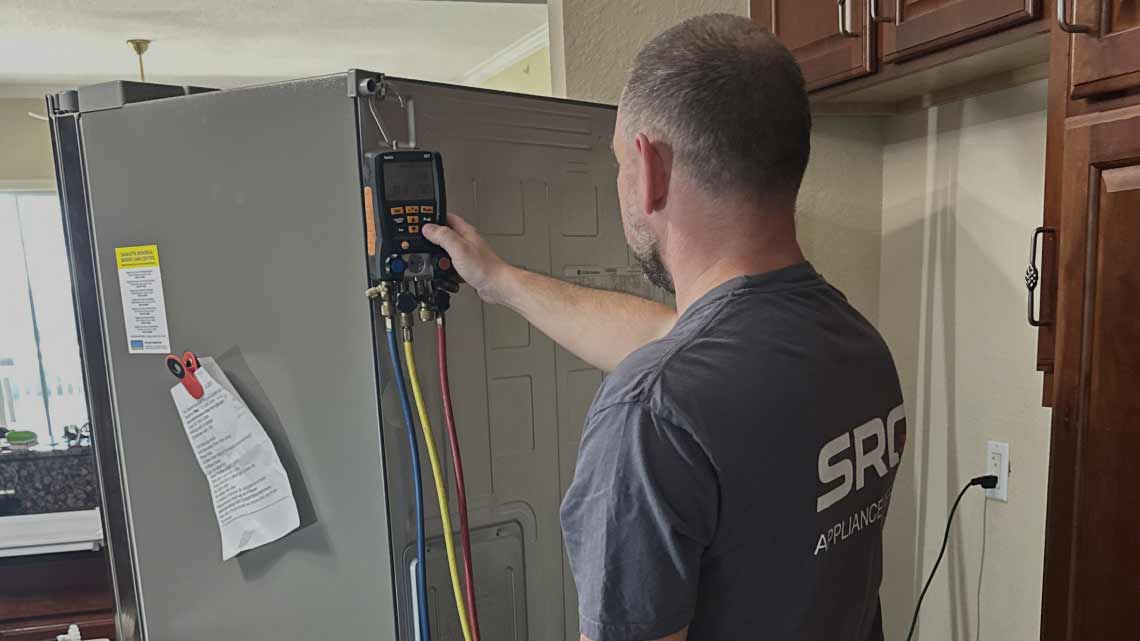
What this guide does is walk you through the eight things that actually cause this, in the order you should check them. Some take two minutes and cost nothing. Others need a technician. If you’d rather skip the trial-and-error process, professional appliance repair Sarasota can quickly diagnose the issue and restore proper temperature control. We’ll tell you which is which, and — since Sarasota’s heat and humidity speed up certain types of wear — we’ll flag what’s especially relevant for homes in this area.
Cause #1 — Temperature Set Too Low
Start here, every time. It sounds obvious, but the temperature dial or digital panel gets bumped more often than people realize — by a grocery bag, a kid reaching for something, a sleeve. A single notch in the wrong direction is enough to drop the fridge into freezing territory.
How to check:
- Digital panel: the displayed temperature should read 35°F to 38°F. Anything below 34°F and you’re in a gray zone.
- Dial controls (numbered 1–5 or 1–7): mid-range is correct. All the way up means all the way cold.
- If you’re not sure what temperature the fridge is actually running at, put a glass of water on the top shelf, leave it 24 hours, then measure with a cooking thermometer.
Cause #2 — Blocked Air Vents
Cold air enters the refrigerator compartment through vents, usually set into the back wall. When something is sitting directly in front of those vents, that item gets hit with a steady stream of freezer-cold air while the rest of the fridge gets uneven cooling. The item in front freezes. The items at the far end may actually warm up.
How to check:
- Look for a plastic panel with slotted openings on the rear or side wall — that’s the vent.
- Common offenders: two-liter bottles, tall juice containers, bags that flop against the back wall.
- If freezing is concentrated at the top shelf or along the back, blocked vents are the most likely cause.
Cause #3 — Faulty Temperature Sensor (Thermistor)
The thermistor is a small probe, usually tucked somewhere along the back wall or ceiling of the refrigerator compartment. Its job is to measure air temperature and relay that reading to the control board. When the board knows the fridge is at 37°F, it tells the compressor to back off. When the thermistor sends the wrong number, the compressor keeps running — and the temperature keeps dropping.
How to check:
- If you’ve already confirmed the temperature setting is correct but the fridge is still freezing, the thermistor is worth suspecting.
- A technician tests it with a multimeter. On Whirlpool-platform models, the correct resistance at refrigerator temperature is around 28K ohms. A reading of 10K means the sensor is reporting a much warmer temperature than reality — so the board keeps cooling.
Cause #4 — Leaking Door Gasket
The gasket is the rubber strip that runs around the interior edge of the door. It creates an airtight seal when the door closes. When it starts to fail — through cracking, stiffening, or pulling away from the frame — warm air leaks in around the edges. The fridge detects a temperature rise and runs the compressor longer to compensate. Run it long enough and the temperature swings past the freezing point.
How to check:
- Close the door on a dollar bill or a folded piece of paper. If you can slide it out without resistance, the seal isn’t gripping properly.
- Run your fingers slowly along the door edge while the fridge is running — a leaking gasket sometimes lets you feel a trace of cold air escaping outward.
- Look closely at the rubber itself. Cracks, a shiny/hardened texture, mold growing in the folds, or sections that visibly gap away from the door frame are all signs it needs replacing.
Cause #5 — Ice Maker Left On Without Water Supply
This one is specific enough that people rarely think to check it. If your refrigerator has a built-in ice maker that’s switched on but not plumbed to a water line, the ice maker will keep trying to run its cycle indefinitely. Each failed cycle releases a burst of cold air into the fresh food compartment — and over time, that extra cold air adds up.
How to check:
- Is the ice maker set to “on” but your fridge isn’t connected to a water supply?
- Are the crisper drawers freezing while the rest of the fridge seems normal? The cold air from a cycling ice maker tends to collect at the bottom.
- Can you hear the ice maker running on a regular cycle but producing nothing?
Cause #6 — Dirty Condenser Coils
Condenser coils do one thing: they release the heat that gets pulled out of the refrigerator during the cooling cycle. When they’re coated in dust, pet hair, and general household debris — which happens naturally over time, faster in homes with pets — they can’t shed heat efficiently. The compressor works longer to make up for it, and the fridge runs colder than it should.
How to check:
- On older models, the coils are on the back of the unit. On most refrigerators made in the last 15 years, they’re underneath, behind a kick plate at the front bottom.
- Pull the fridge out or pop the kick plate. If the coils look like a dust bunny farm, they’re overdue for cleaning.
- Florida households with pets should be doing this twice a year. Everyone else, once a year minimum.
Cause #7 — Malfunctioning Damper Control
The damper sits at the junction between the freezer and the refrigerator compartments. Think of it as a valve — it opens to let cold air through when needed and closes when the fridge has reached the right temperature. When ice builds up around it, the motor burns out, or the mechanism breaks, it can get stuck open. From that point on, cold air flows freely and constantly, and the fridge has no way to stop it.
How to check:
- The damper is usually behind a plastic cover near the top or back of the refrigerator compartment.
- If freezing is concentrated near the top of the fridge — on the top shelf, near the back wall — a stuck damper is a strong candidate.
- If you can access it, check whether the flap moves freely or appears iced over.
Cause #8 — Faulty Main Control Board
The control board sits at the top of the diagnostic list for a reason: everything else feeds into it. Temperature sensor readings, damper motor signals, defrost cycles — the board manages all of it. When it develops a fault, it can misread or ignore sensor data entirely, running the compressor on a loop with no temperature feedback at all. The fridge drops to freezer-level temperatures and stays there.
Control board failures aren’t the most common cause of food freezing, but they’re also not rare. They tend to occur in refrigerators over seven years old, after power surges, or in units that have had multiple attempted repairs that didn’t fully resolve the issue.
When to Stop Guessing and Call Someone
The first four causes on this list — wrong temperature, blocked vents, dirty coils, and a failing gasket — are genuinely within reach for most homeowners. The tools required are minimal, the parts are cheap, and the process is forgiving. If those don’t fix it, you’re likely dealing with a thermistor, damper, or control board issue, and that’s where professional appliance repair Sarasota stops being optional.
A technician with the right diagnostic equipment can measure thermistor resistance, test the damper motor, and pull fault codes from the control board in a single visit. That’s hours of elimination compressed into one appointment. For appliance repair in Sarasota FL, a local shop almost always means faster scheduling and a technician who understands Florida-specific wear patterns — something a national service chain rarely offers.
If you’ve been searching for SRQ Appliance Repair — the shorthand that locals around Sarasota-Bradenton International use — look for a company with documented reviews on Google, transparent service call pricing, and technicians who list specific brand certifications. A company that will tell you the repair isn’t worth it on a 12-year-old unit is worth more than one that will replace parts indefinitely.
Name:
SRQ Appliance Repair
Address:
3959 Yellowstone Cir Sarasota 34233
Phone:
(941) 233-0641
Website:
https://srq-appliancerepair.com/
Hours:
Mon-Fri: 8:00 a.m. – 7:00 p.m.
Sat: 10:00 a.m. – 2:00 p.m.
Sun: Closed
Conclusion
A refrigerator freezing food almost always comes down to one of eight fixable causes. Start with the free fixes: check the temperature setting, unblock air vents, and disable an unused ice maker. These three steps alone resolve most cases.
If the problem continues, inspect the door gasket and clean the condenser coils — both are low-cost, DIY-friendly repairs. Persistent freezing after that points to a faulty thermistor, stuck damper, or control board, and that’s when calling a Sarasota technician makes more sense than guessing. Don’t replace the fridge before you’ve ruled out the basics.
Frequently Asked Questions

Hi Sarasota! My name is Vitalii. I’ve been repairing home appliances in Sarasota and the surrounding areas for many years. I know this field inside and out! Here I share my experience and practical tips. I’d truly appreciate your shares, questions, and comments. Thank you!