


You walk up to the fridge, press the glass against the lever, and… nothing. No trickle, no sputter, just silence. Feels small until you realize how much you depend on that feature — filling the dog’s bowl, grabbing a cold drink at midnight, topping off a bottle on the way out.
The good news: a refrigerator water dispenser not working is almost never a sign the fridge itself is failing. In years of handling appliance repair Sarasota, I can count on one hand the dead dispensers that turned out to be a dying compressor. It’s almost always something smaller — a filter past its prime, a tube that froze, a valve that quit, or a child lock button somebody hit by accident. Cheap fixes. Quick fixes.
This guide covers every cause I’ve run into, from thirty-second fixes to jobs that genuinely need a tech. Let’s figure out what happened to your water.
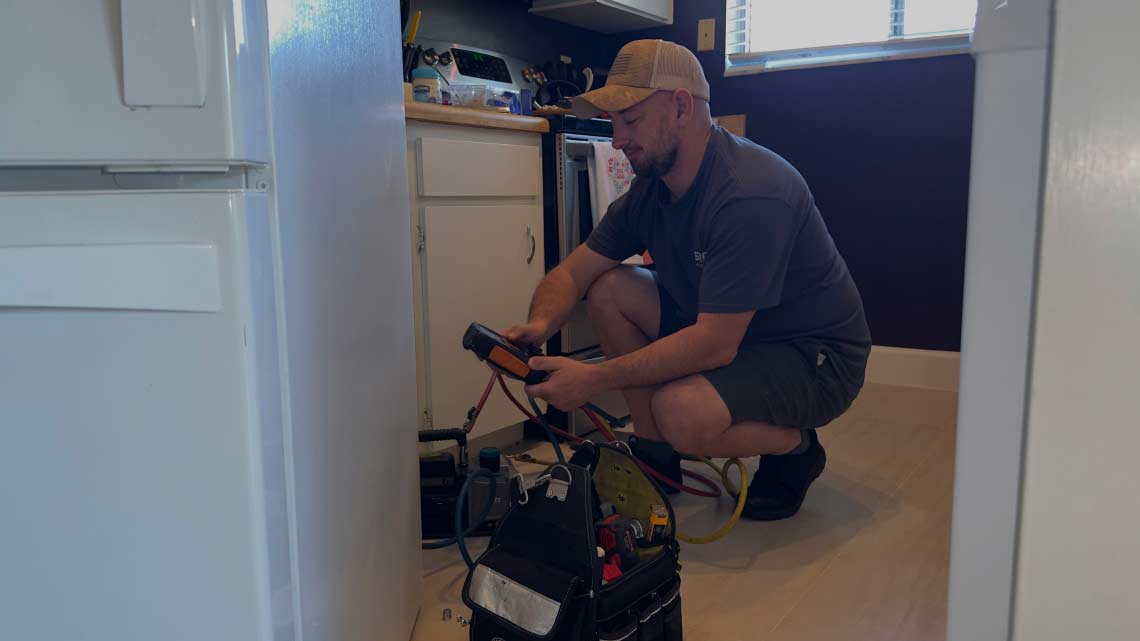
1. Clogged Water Filter (The #1 Culprit)
This is the fix that solves roughly half of all fridge water dispenser complaints — and the one most people overlook because they forgot the filter existed. That carbon cartridge inside your fridge traps sediment, chlorine, minerals, and whatever else is floating through Sarasota’s municipal water. Works great. Until it doesn’t.
After six to twelve months, the filter gets so packed with gunk that water pressure drops to a sad trickle. Leave it long enough and the flow stops entirely. If your fridge has a “Change Filter” indicator light, check it. If it’s on, there’s your answer. If your fridge doesn’t have one, count backward — when did you last swap the filter? Can’t remember? That’s also your answer.
The fix is dead simple:
- Locate the filter — usually upper right corner inside the fridge, behind a bottom kick plate, or in the door. Twist out the old one, twist in the new one.
- Then — and people skip this step — run a full gallon of water through the dispenser before you drink any. That first gallon flushes carbon dust, and trust me, you don’t want black-speckled water in your glass.
2. Frozen Water Line Inside the Door
This one’s sneaky. The water supply tube runs through the freezer door on most side-by-side and French door models. If your freezer is cranked down too cold — below 0 °F — that tube can freeze solid. Water dispenser is dead, but the ice maker still works fine because it has a separate feed. Classic symptom that throws people off.
Once it thaws, bump the freezer temp up to 0 °F. That’s cold enough for food safety and warm enough to keep the water line from refreezing. If the line keeps freezing even at the right temperature, you might have a defective door heater — and that’s a job for the techs at SRQ Appliance Repair, not a hair dryer.
3. Water Inlet Valve Failure
The water inlet valve lives at the back of your refrigerator, usually near the bottom. It’s a solenoid-operated gate — when you press the dispenser lever, the control board sends voltage to the valve, the solenoid opens, and water flows in from your house supply. When it fails, pressing the lever does absolutely nothing. No hum, no click, no trickle. Dead silence.
Before you replace it, check two things.
- First, make sure the little mesh screen inside the valve isn’t clogged with sediment. Shut off the water supply, disconnect the line, and look. A toothbrush and some white vinegar cleans it up in two minutes.
- Second, test the solenoid coils with a multimeter — you want continuity. No reading? The coil is shot and the valve needs replacing.
A replacement water inlet valve runs $30–$80 for the part. Installation is doable if you’re comfortable working with water lines and basic wiring. If you’d rather not risk a leak behind the fridge, a call to appliance repair in Sarasota FL gets it done in under an hour with a warranty on the work.
4. Dispenser Switch and Actuator Problems
- When you press your glass against the dispenser lever, you should hear a click. That click is the dispenser actuator — a little plastic arm — pushing against a micro switch behind the control panel. The switch sends power to the inlet valve. Click happens, valve opens, water comes out. That’s the chain.
- If you press the lever and hear nothing — no click, no hum — the actuator might be cracked or the pivot is worn out. Pop the control panel cover off (usually two screws), inspect the plastic parts. If the actuator looks fine but still doesn’t trigger the switch, the micro switch itself could be dead.
- You can test it with a multimeter set to Rx1 — should read between 200 and 500 ohms. Anything else means it needs replacing.
Micro switches are cheap — maybe $10–$20 for the part. But getting to them can be fiddly on some models, especially Samsung French doors where everything is packed tight behind that panel. If the mechanical side checks out and there’s still no water, the problem moves upstream to the control board.
5. Low Water Pressure From the House
Here’s one that has nothing to do with the refrigerator. Your fridge water dispenser needs at least 20 psi of incoming pressure to function. Some models want 40. If household pressure is low — main line partially closed, pressure regulator too tight, sprinklers and dishwasher running simultaneously — the dispenser barely trickles or quits entirely.
I see this often in older Sarasota neighborhoods where galvanized pipes have decades of calcium buildup choking the flow. Fix ranges from simple (open the valve wider, adjust the regulator) to involved (replumbing a section). Either way, the fridge is innocent.
6. Control Board Glitches
Modern fridges are basically computers that happen to keep food cold. The dispenser control board — a small circuit board behind the front panel — manages everything: which mode you’re in (water, crushed ice, cubed ice), whether the lock is engaged, and when to fire the inlet valve. Sometimes the board just… glitches. Especially after a power surge or an outage — and in Sarasota during hurricane season, that happens plenty.
If the reset doesn’t do it and every other component tests fine — filter clean, valve good, actuator clicking, water pressure strong — the control board itself may be fried.
Replacement boards cost $100–$300 depending on the model, and installing one requires swapping ribbon cables and connectors that are easy to misroute. I’d recommend leaving that one to appliance repair professionals who deal with boards every week.
How Much Does a Repair Cost?
Ballpark numbers so you know what you’re walking into. Water filter replacement: $20–$50, do it yourself. Inlet valve swap: $150–$250 installed. Frozen line thaw plus thermostat adjustment: $100–$180 service call. Micro switch or actuator: $80–$150. Control board: $250–$450 with labor.
The outlier is the compressor — but if your water dispenser stopped working, the compressor is almost never the reason. Don’t let anyone tell you otherwise unless the whole fridge is warm.
When DIY Stops Making Sense
Swapping a filter? Anyone can do that. Thawing a line with a hair dryer? Sure, just be careful. But the moment you’re pulling out a multimeter to test solenoid coils or disassembling the control panel to inspect micro switches, you’ve crossed into territory where one wrong move creates a bigger bill than the original problem.
Across Sarasota, homeowners trust same day refrigerator repair techs to handle water dispenser repairs quickly — fixed in one visit, usually the same day you call. And for those middle-of-the-night moments when the fridge starts leaking from a botched DIY line job, emergency refrigerator repair gets somebody to your door before the floor damage gets worse.
Name:
SRQ Appliance Repair
Address:
3959 Yellowstone Cir Sarasota 34233
Phone:
(941) 233-0641
Website:
https://srq-appliancerepair.com/
Hours:
Mon-Fri: 8:00 a.m. – 7:00 p.m.
Sat: 10:00 a.m. – 2:00 p.m.
Sun: Closed
Frequently Asked Questions

Hi Sarasota! My name is Vitalii. I’ve been repairing home appliances in Sarasota and the surrounding areas for many years. I know this field inside and out! Here I share my experience and practical tips. I’d truly appreciate your shares, questions, and comments. Thank you!