


You open the washer expecting clean, slightly damp clothes. Instead there’s a tub full of gray water and a soggy mess floating in it. Washer not draining. Annoying, but rarely fatal — and most of the time it’s something you can sort out yourself in half an hour.
I run appliance repair Sarasota calls for this constantly, and I’d guess seven out of ten “won’t drain” jobs come down to a clog somewhere — coin trap, hose, or pump impeller. Cheap fixes. The other three are a dead pump or a control issue, which is where a tech comes in.
But before you touch anything, get the water out. Bail it with a cup into a bucket, or drop the drain hose into a low bucket and let gravity pull the water out. Towels down. You don’t want to work on a machine that’s about to dump two gallons on your floor.
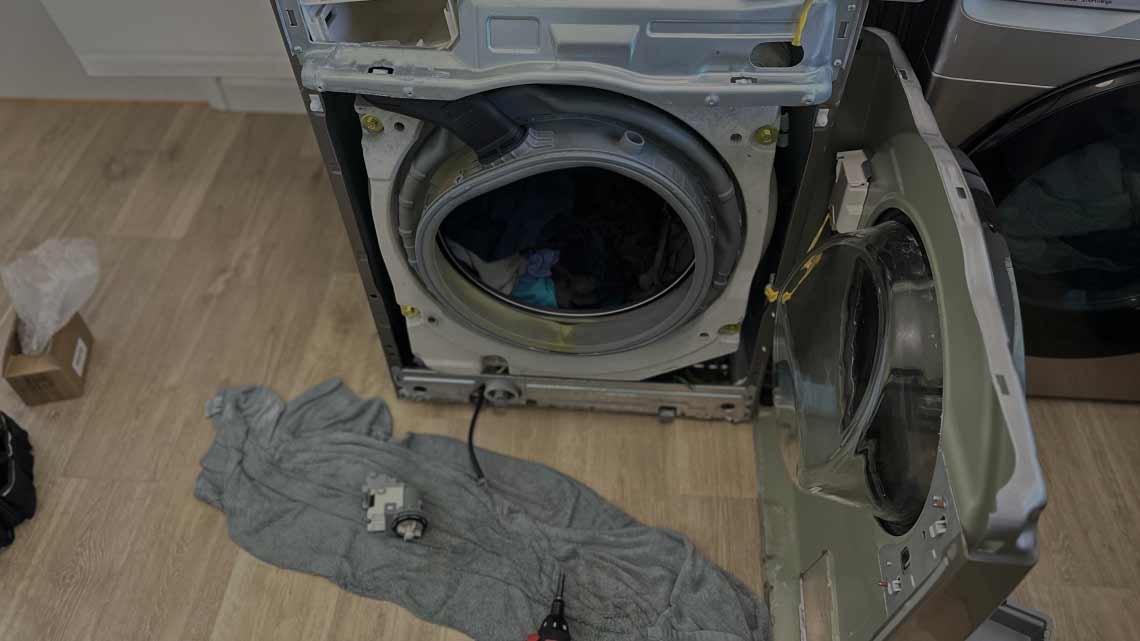
1. The Coin Trap (Front-Loaders)
If you’ve got a front-loader, this is the first place to look — and it solves more drain problems than anything else.
- Down at the bottom front of the machine there’s a small access panel. Pop it open. Behind it you’ll find a round screw cap — that’s the drain pump filter, often called the coin trap. It’s there to catch everything that falls out of your pockets before it reaches the pump.
- Lay a towel and a shallow pan underneath, because water WILL come out — usually a quart or more. Unscrew the cap slowly and let it drain. Then reach in. You’ll be amazed. Coins, hair clumps, bobby pins, buttons, a child’s sock, sometimes a small toy.
- Clean it out, rinse the filter under the tap, screw it back in tight, and run a drain cycle. Half the time, that’s the whole repair. Manufacturers recommend cleaning this filter every few months — almost nobody does, which is exactly why I stay busy.
2. Clogged Drain Hose
No coin trap, or the trap was clean? Move to the drain hose. This is the corrugated hose running from the back of the washer up to your standpipe or laundry sink.
- Pull the washer out from the wall, disconnect the hose from the standpipe, and lower the end into a bucket. If water gushes out, the hose was fine and the blockage is upstream — likely the pump. If nothing comes out, the hose itself is plugged.
- Detach both ends and look through it. Lint, sludge, sometimes a sock that made it past the drum. Run a garden hose through it at full pressure to blast the clog loose, or feed a plumber’s snake through. Reattach, run a drain cycle.
One thing folks miss: the standpipe in the wall can clog too, not just the washer hose. If your hose is clear but water still backs up, the building drain line might be the culprit. That’s a plumber’s job, not an appliance tech’s — appliance repair Sarasota FL techs will tell you straight if the problem is past the washer and into your home plumbing.
3. The Drain Pump Itself
If the trap and hose are clear and the machine still won’t drain, the pump is the prime suspect. The drain pump is what physically pushes water out — when it fails, water just sits there.
Two failure modes:
First, the impeller (the little fan inside the pump) gets jammed by debris — a coin or a fragment of fabric wedged in the blades. Sometimes you can clear it by hand once you access the pump.
Second, the pump motor burns out. You’ll often hear it: a humming or buzzing when the machine tries to drain, but no water moves. That hum is the motor straining against a jam or a dead winding.
HOW TO CHECK:
To check, you’ll need to access the pump — behind the front or back panel depending on the model. Look for debris in the impeller, spin it by hand. If it’s seized, clear it. If the motor’s dead, the pump needs replacing.
Drain pump replacement runs $200–$300 installed in Sarasota. Most of that is labor — the part itself is $40–$80. A same day washer repair tech usually carries common pump models on the truck, so it’s typically a one-visit fix.
4. Kinked or Bad Hose Routing
Sometimes there’s no clog at all — the hose is just kinked. Washers get shoved back against the wall and the drain hose folds behind them like a crimped straw. Water can’t get through.
- Pull the machine out and look at how the hose runs. Straighten any kinks. Make sure it isn’t crushed between the washer and the wall.
- Also check the height. The drain hose needs to loop up to a certain height before draining — usually 30 to 36 inches off the floor, depending on the machine. If it’s draining into a pipe that’s too low, or pushed too far down into the standpipe, you get a siphon effect that messes with the drain cycle. The hose should sit secure but not jammed deep into the pipe.
5. Lid Switch and Door Lock
Here’s a sneaky one. On a lot of machines, the drain cycle won’t run if the lid switch or door lock isn’t engaged. The washer thinks the door is open and refuses to drain as a safety measure.
Top-loaders: if the lid switch is bad, the machine may fill and wash but skip the drain and spin entirely.
Front-loaders: if the door lock won’t confirm, same deal.
If your washer fills and agitates fine but stops dead before draining, and you’ve ruled out clogs, test the lid switch or door lock before assuming it’s the pump. I covered lock diagnosis in detail in our washer-won’t-start guide — same component, different symptom.
6. When Draining and Spinning Both Fail
Washer not draining or spinning together is one of the most common combos I see — and it’s usually a single cause, not two.
Here’s why: most washers won’t spin until they’ve drained. It’s a safety sequence. The machine won’t whip a tub full of water around at 800 RPM and flood your laundry room. So when the drain fails, the spin never starts, and people think two things broke at once. Nope. Fix the drain — clear the clog or replace the pump — and the spin comes right back. So if you’re dealing with both at the same time, focus entirely on the drain. The spin will follow.
Brand Quirks: Samsung, LG, Whirlpool
- Samsung. Front-loaders are notorious for the coin trap clogging fast, and Samsung throws specific error codes — like 5E (or SE) — that mean drain failure. If you see that code, go straight to the coin trap and pump. Samsung’s debris filter clogs faster than most brands because of the design.
- LG. Direct-drive LG washers show OE as the drain error. Usually it’s the pump filter or a kinked hose. LG pumps are reliable, so check the simple stuff first before assuming the pump died.
- Whirlpool. Top-loaders sometimes have the drain issue traced back to a worn pump or a clog in the tub-to-pump hose, which is a known weak point. Whirlpool parts are cheap and everywhere, so repairs land on the lower end of the price range.
Whatever the brand, the diagnostic order is the same: trap, hose, pump, switch. Work it in that sequence and you’ll find it.
When to Call a Pro
DIY: Clearing the coin trap, flushing the hose, straightening a kink. That handles most drain failures and costs you nothing but thirty minutes and a dirty towel.
PRO: But if the trap and hose are clean, the pump hums but won’t move water, or you’re seeing a drain error code that won’t clear after the basics — that’s pump or control board territory. Accessing and replacing a pump means tilting the machine, disconnecting wiring and hoses, and working in a tight space with residual water everywhere. Doable, but messy and easy to botch.
That’s when an emergency washer repair tech earns the call. Fifteen minutes to diagnose, common pumps on the truck, one visit, done. No standing water sitting in your drum for three days breeding that mildew smell while you wait for a part off Amazon.
Name:
SRQ Appliance Repair
Address:
3959 Yellowstone Cir Sarasota 34233
Phone:
(941) 233-0641
Website:
https://srq-appliancerepair.com/
Hours:
Mon-Fri: 8:00 a.m. – 7:00 p.m.
Sat: 10:00 a.m. – 2:00 p.m.
Sun: Closed
Frequently Asked Questions

Hi Sarasota! My name is Vitalii. I’ve been repairing home appliances in Sarasota and the surrounding areas for many years. I know this field inside and out! Here I share my experience and practical tips. I’d truly appreciate your shares, questions, and comments. Thank you!