


Stop the water first — read this before anything else.
If your washer is overflowing right now, skip the diagnosis. Do this:
- Turn off both hot and cold supply valves behind the machine. Righty tighty, all the way closed. If they’re stuck or corroded — common in older Sarasota homes with humidity-baked fittings — go to your main water shutoff and kill it there.
- Unplug the washer. Don’t reach behind a machine standing in water — get to the breaker instead and shut off the laundry circuit. Water and 120 volts is not a combination you experiment with.
- Then start moving water. Towels, a wet vac, a mop bucket. Get it off the floor before it finds the baseboards and the subfloor.
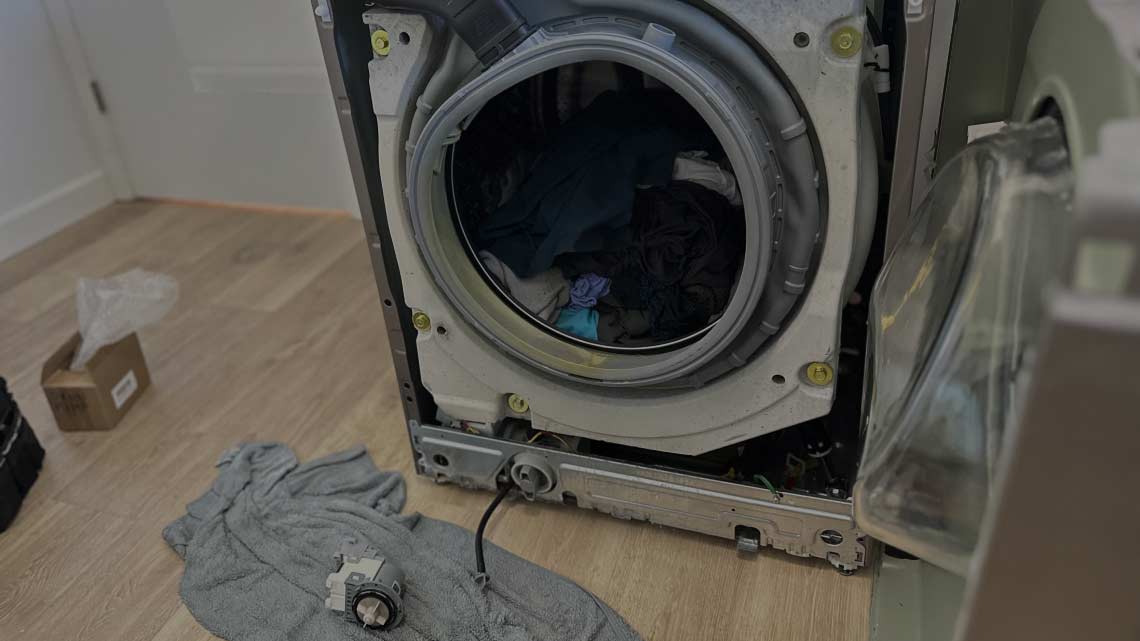
Once the water’s stopped and the mess is contained, then you figure out why. I take appliance repair Sarasota calls for overflows and the damage is almost always worse than the repair — a $180 valve that flooded a laundry room and cost three grand in flooring. Speed matters more than diagnosis in the first five minutes.
Cause One: Water Inlet Valve Stuck Open
This is the number one cause, and it’s the one that floods houses.
The inlet valve sits at the back of the machine where your hot and cold hoses connect. Inside are two solenoids that open to let water in and close when the machine has enough. When a solenoid fails in the open position — worn seat, mineral scale, a piece of debris — water keeps coming. The machine has no way to stop it.
The tell: the washer fills past the normal level and keeps going. Doesn’t matter what cycle you selected. Doesn’t matter if the machine is running. Water just keeps coming in.
Quick check: shut the machine off completely. Does water still trickle into the drum? If yes, that’s a stuck valve — nothing else does that. Shut off the supply valves and don’t turn them back on until it’s replaced.
Sarasota’s hard water is rough on these valves. Mineral deposits build up on the solenoid seat until it can’t seal. I pull valves out of five-year-old machines here that look like they’ve been running a decade somewhere else.
Cause Two: Failed Pressure Switch or Water Level Sensor
If the valve is fine, this is the next suspect. The pressure switch — sometimes called the water level sensor — is what tells the control board how much water is in the tub. It’s the machine’s only way of knowing when to stop filling. Here’s how it works. A small tube runs from the bottom of the tub up to the switch. As water rises, air gets trapped and compressed in that tube. The switch reads the pressure and translates it to water level. Hits the target, switch trips, board closes the valve.
When the switch fails, it never sends the “full” signal. The board keeps the valve open, waiting for a message that never arrives. Water rises past the door and over the top.
Different symptom from a stuck valve: with a bad pressure switch, the overfill only happens while a cycle is running. Machine off means no water. That’s how you tell them apart.
Pressure switches are a defined replacement, and a same day washer repair tech can test one with a multimeter in a couple of minutes.
Cause Three: Clogged Air Dome Tube
This one’s underrated and it’s cheap to fix — which is why it’s worth checking before you buy parts.
That tube running from the tub to the pressure switch can clog. Lint, detergent sludge, and hard water scale build up inside it over years. Once it’s blocked, air can’t compress properly, the switch reads a lower water level than reality, and the machine keeps filling.
Same symptom as a bad pressure switch, completely different fix. The switch is fine — it just isn’t getting accurate information.
Fix: disconnect the tube at both ends, flush it out with warm water, blow it clear, check for cracks or kinks while it’s off. Reattach. Sometimes that’s the whole repair, for free.
Any tech worth calling checks the tube before condemning the switch. If someone quotes you a pressure switch without looking at that tube first, get a second opinion.
Cause Four: Control Board Failure
The board is what actually commands the valve to open and close. Everything else — the switch, the tube — just feeds it information. If the board’s relay controlling the water valve sticks closed, or the board fries, it can hold the valve open regardless of what the sensors say.
In Sarasota, boards die from power surges. Summer storms, lightning, hurricane season. A surge comes through, damages a relay, and now your washer overfills. It might work fine otherwise — that’s what makes it confusing.
First move: unplug for five minutes and plug back in. Hard reset. Clears glitches. If the overfill continues after a reset and both the valve and pressure switch test good, the board is the prime suspect.
Diagnosing this properly takes a multimeter and the model’s wiring diagram — you’re checking whether voltage is reaching the valve when it shouldn’t be. Appliance repair in Sarasota FL techs carry that gear and can confirm board failure before you order an expensive part you might not need.
Cause Five: Too Much Detergent (Suds Overflow)
Not every overflow is water. Sometimes it’s foam — and this one’s on you, not the machine.
Pour regular detergent into an HE machine, or dump a full cap into an HE washer that needs half, and you get a suds mountain. The foam expands, pushes up past the door seal on front-loaders or over the top on top-loaders, and runs down onto the floor. Looks like an overflow. Technically it is one. But nothing is broken.
Worse, excess suds confuse the pressure switch. The machine can misread the level and keep filling on top of the foam problem.
Fix: use HE detergent in HE machines, and use half of what you think you need. Most people massively overdose. A modern HE washer needs maybe two tablespoons for a normal load, not a full cap.
If you’ve got a suds overflow happening, run an extra rinse cycle with no detergent to flush it out. Then dial back the soap permanently.
Cause Six: Drain Standpipe Backing Up
Here’s the one that isn’t the washer’s fault at all.
Your drain hose empties into a standpipe in the wall. If that pipe is partially clogged — lint, soap scum, decades of buildup — water can’t drain as fast as the washer pumps it out. It backs up the pipe and spills out the top onto the floor.
Symptom that gives it away: the overflow happens during the drain cycle, not during fill. Water isn’t coming out of the machine’s tub — it’s coming out of the wall pipe.
Test: pull the drain hose out of the standpipe and run water down the pipe from a bucket or hose. Drains slowly or backs up? That’s your problem, and it’s a plumber’s job, not an appliance tech’s.
Older Sarasota homes with original cast iron drain lines are the usual suspects. Decades of buildup narrows the pipe until a modern washer’s pump rate overwhelms it.
If you’ve got a suds overflow happening, run an extra rinse cycle with no detergent to flush it out. Then dial back the soap permanently.
The Sneaky One: Filling When the Machine Is Off
This deserves its own section because it’s the scenario that does the most damage.
Washer is off. Nobody’s home. House water pressure slowly pushes past a worn inlet valve seat. Water trickles into the drum for hours. Eventually it overflows and just keeps running — because nothing is going to stop it.
If you’ve ever come home to water in the drum you didn’t put there, that’s a stuck inlet valve and it’s a ticking clock. Shut off the supply valves at the wall right now, and call SRQ Appliance Repair before you use the machine again. Don’t wait for it to get worse — it will.
And honestly, this is why every appliance tech tells you to shut the supply valves when you leave town. A five-second habit that prevents a five-figure problem.
What It Costs and Who Fixes What
| Inlet valve replacement | Appliance tech | One visit, part usually on the truck |
| Pressure switch or air dome tube | Appliance tech | The tube might be free — just a cleaning |
| Control board | Appliance tech, but confirm the diagnosis first | Boards are the most expensive part in the machine |
| Suds overflow | You | Change detergent, use less. Costs nothing |
| Standpipe clog | Plumber | This one’s your home’s plumbing, not the washer |
If you’re not sure which category you’re in, that’s exactly what a diagnostic visit is for. An emergency washer repair tech will tell you honestly if the problem is past the washer and into your walls.
Preventing the Next Flood
- Shut the supply valves when you travel. Vacation, work trip, snowbird season — any time the house sits empty more than a couple of days.
- Replace rubber fill hoses every five years, or switch to braided stainless. Rubber gets brittle in Florida heat and blows out.
- Never run a load and leave the house. It’s the single most common way a small leak becomes a flood.
- Consider a drain pan under the machine, especially in second-floor laundry rooms and condos. It won’t stop a real flood, but it catches slow leaks before they reach the subfloor.
- Use half the detergent you think you need, and use HE soap in HE machines.
- And if your washer ever fills when it’s off — even a little — deal with it immediately.
Name:
SRQ Appliance Repair
Address:
3959 Yellowstone Cir Sarasota 34233
Phone:
(941) 233-0641
Website:
https://srq-appliancerepair.com/
Hours:
Mon-Fri: 8:00 a.m. – 7:00 p.m.
Sat: 10:00 a.m. – 2:00 p.m.
Sun: Closed
Frequently Asked Questions

Hi Sarasota! My name is Vitalii. I’ve been repairing home appliances in Sarasota and the surrounding areas for many years. I know this field inside and out! Here I share my experience and practical tips. I’d truly appreciate your shares, questions, and comments. Thank you!