


Push the start button, nothing happens. Before you do anything else, figure out which version of “won’t start” you’ve got — because they point to completely different causes.
- Version one: total death. No lights, no display, no sound. The machine acts unplugged. That’s a power problem nine times out of ten.
- Version two: lights on, display works, you press start and… it just sits there. Maybe it clicks. Maybe it hums. Maybe the door lock light flashes. The machine has power but won’t begin the cycle. That’s a door lock, control board, or motor issue.
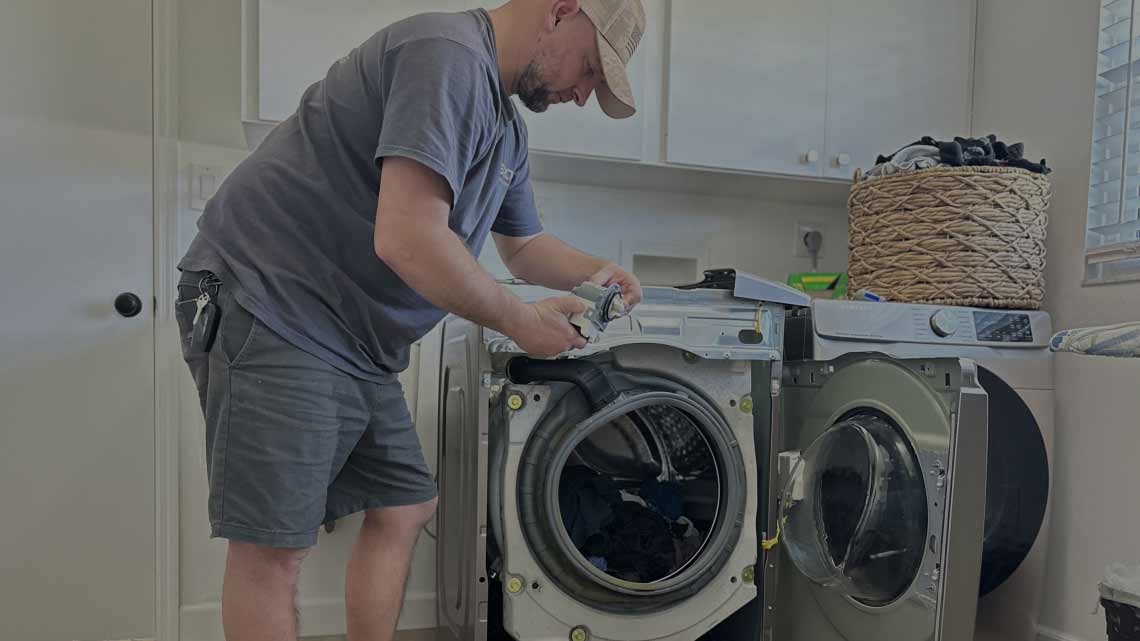
I run appliance repair Sarasota calls for both kinds every week, and knowing which camp you’re in cuts the diagnosis time in half.
Figure that out first, then work down the list below.
1. Power: Check This Before Anything Else
If the machine is dead silent, start here. I know it sounds obvious. You’d be amazed how many service calls end with me plugging a washer back into an outlet that vibrated loose.
- Check the plug. Washers shake. Over months the plug works its way out of the outlet a quarter inch — enough to lose contact. Push it firmly back in.
- Check the breaker. Go to your panel and find the laundry circuit. If it’s tripped, it’ll be sitting between ON and OFF. Flip it all the way OFF, then back ON. If it trips again the moment you start the washer, you’ve got a short — stop and call a pro, because that’s an electrical fault, not a nuisance trip.
- Check the outlet itself. Plug a lamp or your phone charger into it. Dead? The outlet’s the problem, not the washer. Could be a GFCI that tripped — a lot of Sarasota laundry rooms have GFCI outlets, and they pop during summer storms. Look for a reset button on the outlet and press it.
And extension cords — don’t. Washers should never run on an extension cord. The voltage drop keeps the motor from starting and can burn it out. Had a guy in North Port running his on a 40-foot cord wondering why it wouldn’t start. Plug it straight into the wall.
2. Door Lock and Lid Switch
If the machine has power but won’t start, this is the most common culprit. Front-loaders won’t run until the door is locked AND the control board confirms it. Top-loaders won’t spin until the lid switch confirms the lid is shut.
Front-loader: close the door firmly until you hear it latch. Listen for the lock to engage after you press start — usually a click or a clunk a second or two in. No click? The door lock assembly is probably dead. They fail constantly on LG and Samsung after three or four years. The wiring inside the lock fatigues, or the latch hook cracks.
Top-loader: the lid switch is a small plastic tab under the lid. Close the lid and listen for the click. Press the switch manually with a pen — hear it actuate? If the machine starts when you press it by hand but not when the lid closes, the lid alignment is off or the switch is worn.
Door lock and lid switch replacements run $180–$250 installed. SRQ Appliance Repair techs swap these daily — it’s the number one “won’t start” repair in this market.
3. Control Lock and Settings
Modern washers have a control lock — a child-lock feature that disables the buttons. If it’s on, you press start and nothing happens, but the display still works.
WHAT TO DO:
Look for a “Control Lock” or padlock icon on the panel. Usually you hold a specific button for three seconds to toggle it off. On many Whirlpool and Maytag models it’s the “Cycle Signal” or “Control Lock” button. Samsung and LG vary — check which button has a little lock printed above it.
Also: make sure you actually selected a cycle. Some machines won’t respond to start until a wash cycle is chosen. And the “delay start” feature — if that got bumped, the machine is waiting to start later and looks dead in the meantime. Cancel any delay and try again.
These cost nothing to fix and account for a surprising number of “broken” washers. Always check before you assume hardware failure.
4. The Start Button Itself
Sometimes the problem is exactly what it looks like — the start button is broken. On machines with mechanical push buttons, the contact behind the button wears out or the button physically cracks. You press it, it depresses, but no signal reaches the board. On touch-panel models, the membrane behind the touch surface fails. You tap “start” and nothing registers, even though the display lights up fine.
Test: try every other button on the panel. If the start button is the only one that doesn’t respond, it’s the button. If none of them respond but the display is lit, the problem is upstream — the user interface board or main control board.
Button or interface board replacement runs $150–$300 depending on the model. Touch panels cost more than mechanical buttons.
5. Control Board Failure
The control board is the brain. It takes your start command, checks the door lock, tells the water valve to fill, and signals the motor. If the board fries, the machine might light up but refuse to do anything — or do nothing at all. Sarasota is hard on control boards. Summer storms, lightning, and hurricane-season power surges kill them regularly. A surge comes through the line, fries a component on the board, and the washer won’t start the next morning.
First thing to try: unplug the washer for five full minutes, then plug it back in. This hard-resets the board. Clears glitches. Works more often than you’d think — especially after a power blip.
If the reset doesn’t do it and you’ve ruled out power, door lock, and the start button, the board is the prime suspect. Diagnosing it for certain takes a multimeter and the model’s wiring diagram. Replacement boards run $250–$400. Appliance repair in Sarasota FL techs carry test gear to confirm board failure before ordering an expensive part you might not need.
Put your washer on a surge protector after this. Fifteen bucks. Cheapest insurance against the next storm.
6. Thermal Fuse and Wiring
Some washers have a thermal fuse that cuts power if the machine overheats. If it blows, the washer goes completely dead — same symptom as a power problem. The fuse is a safety device; when it trips, it usually means something else overheated, so a tech should check why before just replacing it. Loose or corroded wiring connections cause intermittent no-start issues too. Sarasota’s humidity corrodes terminals over time, especially on machines in un-air-conditioned garages and laundry closets. A connection that looks fine can have enough corrosion to break the circuit.
This is diagnostic territory that needs tools. If you’ve checked everything above and the machine is still dead or unresponsive, the wiring or thermal fuse is worth a professional look.
7. Motor Won’t Engage
If the washer lights up, the door locks, you hear it try — a hum, a buzz — but the drum never moves and the cycle never really begins, the motor or its start components might be the issue. A failed start capacitor (on machines that have one) keeps the motor from getting the jolt it needs to begin spinning. You’ll hear humming as the motor tries and fails. A bad motor control board does the same thing — sends no signal, the motor stays silent.
Motor-related no-start repairs range from $150 for a capacitor to $300–$450 for a motor or motor control board. At the high end, on an older machine, you’re into repair-vs-replace territory. A same day washer repair tech can tell you which it is before you spend a dime on parts.
When to Call a Tech
Power checks, control lock, door alignment, the five-minute reset — all DIY. That covers a big share of “won’t start” cases and costs nothing.
PRO: But once you’re testing a door lock with a multimeter, suspecting a control board, or chasing a thermal fuse, you’ve crossed into territory where a wrong guess gets expensive fast. Control boards and motor parts aren’t returnable once installed, and ordering the wrong one means eating the cost.
A emergency washer repair tech pinpoints the fault in fifteen minutes with the right equipment, and most common parts ride on the truck. One visit, machine running, no guessing.
Name:
SRQ Appliance Repair
Address:
3959 Yellowstone Cir Sarasota 34233
Phone:
(941) 233-0641
Website:
https://srq-appliancerepair.com/
Hours:
Mon-Fri: 8:00 a.m. – 7:00 p.m.
Sat: 10:00 a.m. – 2:00 p.m.
Sun: Closed
Frequently Asked Questions

Hi Sarasota! My name is Vitalii. I’ve been repairing home appliances in Sarasota and the surrounding areas for many years. I know this field inside and out! Here I share my experience and practical tips. I’d truly appreciate your shares, questions, and comments. Thank you!