


Your freezer quit. The ice cream is soft, the chicken breasts feel squishy, and there’s a puddle forming on the kitchen floor. Before you start Googling “new freezer Costco,” take a breath. Most of the time, a freezer that stopped working doesn’t need to be hauled to the curb. It needs a diagnosis.
But here’s the catch if you live in Sarasota: you don’t have the luxury of waiting. When it’s 92 degrees outside with humidity that feels like a wet blanket, a dead freezer means spoiled food in hours, not days. I’ve seen families lose $300–$400 worth of meat and meal prep because they figured they’d “deal with it tomorrow.” Tomorrow, in Southwest Florida, is too late.If you want to avoid food loss and get a fast answer, professional appliance repair Sarasota can diagnose and fix the issue the same day. So let’s walk through what’s probably wrong, what you can handle yourself, and when it’s time to pick up the phone.
The Usual Suspects — Why Freezers Quit in Sarasota
After years of diagnosing appliances in this area, I can tell you: about 80% of freezer failures come down to five things. Some are embarrassingly simple. Others require a professional and a multimeter.
Filthy condenser coils
This is the number-one thing homeowners overlook. Those coils — usually at the bottom behind a kick plate or on the back of the unit — are supposed to release heat. When they’re caked with dust, pet hair, and whatever else accumulates in a Florida kitchen, the compressor can’t reject heat efficiently. It runs hotter, cycles longer, and eventually just can’t maintain 0°F. I pull coil covers off units in Sarasota homes and find half an inch of grime. That’s not neglect — that’s just life with two dogs and central AC circulating everything around the house.
Worn-out door gaskets
The rubber seal around your freezer door degrades over time. It cracks, warps, loses its magnetism. And in a humid climate like ours, a bad gasket doesn’t just let cold air escape — it lets moisture in. That moisture turns to frost on the evaporator coils, which blocks airflow, which makes the freezer work even harder. Vicious cycle. The dollar-bill test is the quickest check: close the door on a bill, try to pull it out. Slides right out? That gasket is done.
Evaporator fan failure
This fan sits inside the freezer compartment and pushes cold air around. When the motor burns out or the blades get jammed by ice buildup, air stops circulating. You’ll notice the freezer feels cold near the back wall but warm everywhere else. Sometimes you can hear it — a grinding or squealing noise that wasn’t there before. Other times, dead silence where there used to be a quiet hum.
Compressor problems
The compressor is the engine of the whole system. It pressurizes refrigerant, drives the cooling cycle, and is by far the most expensive part to replace. When it fails, you get zero cooling. Listen for the hum — if you stand next to the unit for 30 minutes and hear nothing but silence, the compressor may have seized. At that point, you’re looking at a repair bill that often makes replacement the smarter financial move, especially on units over 12 years old.
Start relay failure
The start relay is a small component that kicks the compressor on. When it goes bad, the compressor tries to start, fails, and clicks off — over and over. Unplug the fridge, pull the relay off the compressor (it’s usually a small box that plugs right in), and shake it. Rattle like dice? It’s toast. This is actually one of the cheaper fixes — the part itself runs $15–$40 — but you need to know what you’re looking at.
DIY Troubleshooting That Actually Works
Before you schedule a service call, run through these checks. I’m not talking about YouTube rabbit holes where someone tells you to replace the main control board. I mean practical, no-tools-required steps that solve real problems.
1. Check the obvious
Power cord plugged in? Breaker tripped? Sarasota gets hit with afternoon storms almost daily from June through September, and lightning-induced power surges trip breakers constantly. I’ve driven to service calls only to flip a breaker switch and leave.
2. Look at the thermostat
Somebody bumped the dial. A kid was playing with buttons. The digital display is showing 15°F instead of 0°F. It happens more than you’d think. USDA says 0°F for safe frozen food storage — anything above that and you’re on borrowed time.
3. Open the door and assess
Is the freezer packed like a game of Tetris? The evaporator fan needs space to push air around. If bags and containers are jammed against the back wall and crammed over the vents, there’s your problem. Pull some stuff out, rearrange so there’s breathing room. Ideal fill level is around 75–85%. Full enough to hold cold mass, open enough for circulation.
4. Inspect the frost
A thin, even layer of frost inside? Normal, especially in manual-defrost models. A thick, uneven wall of ice coating the back panel or around the evaporator cover? That’s trouble. It means the defrost cycle isn’t running — could be the defrost timer, the defrost heater, or the defrost thermostat. Unplug the unit, let it thaw for 12–24 hours with towels on the floor, plug it back in. If it freezes up again within a week, the defrost system needs professional attention.
5. Clean those coils
Pull the fridge away from the wall. Pop off the bottom panel. Grab a coil brush or the crevice tool on your vacuum. Five minutes of work that can drop the compressor temperature by 10–15 degrees and bring a struggling freezer back to life.
Red Flags That Mean “Call a Tech Now”
Not everything is a DIY project. Some symptoms tell you the problem is beyond coil-cleaning territory.
That compressor is fighting a losing battle — could be low refrigerant from a leak, a failed condenser fan, or the compressor itself is worn out. Running it in this state just drives up your electric bill and accelerates the damage.
A burnt-plastic smell near the back of the unit can mean a relay or compressor overheating. A chemical, sweet odor might indicate a refrigerant leak. Neither of these is something you should investigate with a screwdriver and a YouTube tutorial. Refrigerant handling requires EPA certification for good reason.
A freezer that repeatedly trips its breaker has an electrical fault — possibly a short in the compressor windings or a bad defrost heater. This is a fire risk, not just an appliance inconvenience.
That’s the compressor trying and failing to start. The start relay or the compressor itself is the issue. Every failed start attempt puts stress on the electrical system.
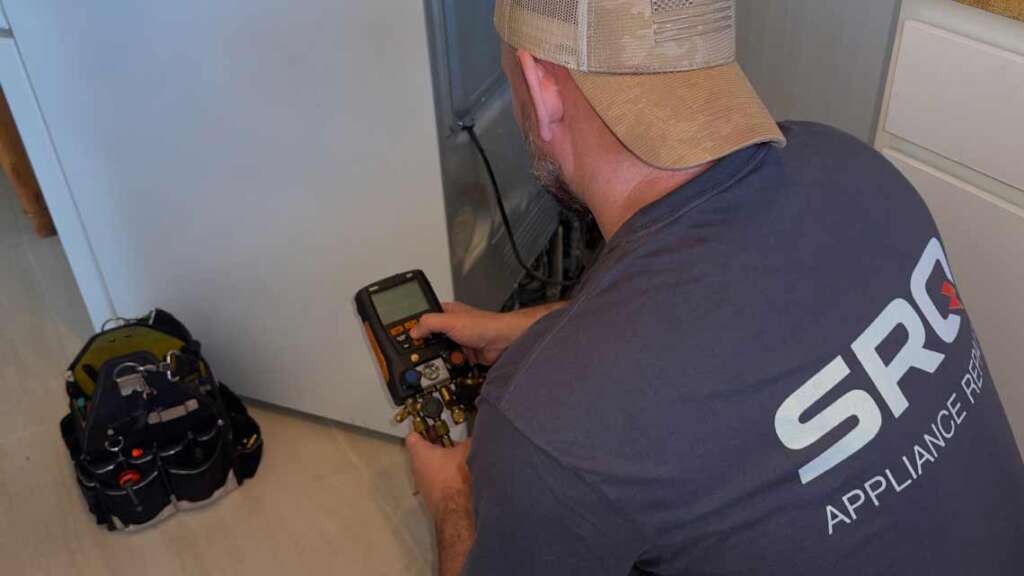
For situations like these, SRQ Appliance Repair has technicians who carry the parts and diagnostic tools to handle compressor replacements, sealed-system repairs, and electrical troubleshooting on site. Trying to DIY a sealed refrigerant system isn’t just impractical — it’s illegal without proper certification.
Name:
SRQ Appliance Repair
Address:
3959 Yellowstone Cir Sarasota 34233
Phone:
(941) 233-0641
Website:
https://srq-appliancerepair.com/
Hours:
Mon-Fri: 8:00 a.m. – 7:00 p.m.
Sat: 10:00 a.m. – 2:00 p.m.
Sun: Closed
Frequently Asked Questions

Hi Sarasota! My name is Vitalii. I’ve been repairing home appliances in Sarasota and the surrounding areas for many years. I know this field inside and out! Here I share my experience and practical tips. I’d truly appreciate your shares, questions, and comments. Thank you!